



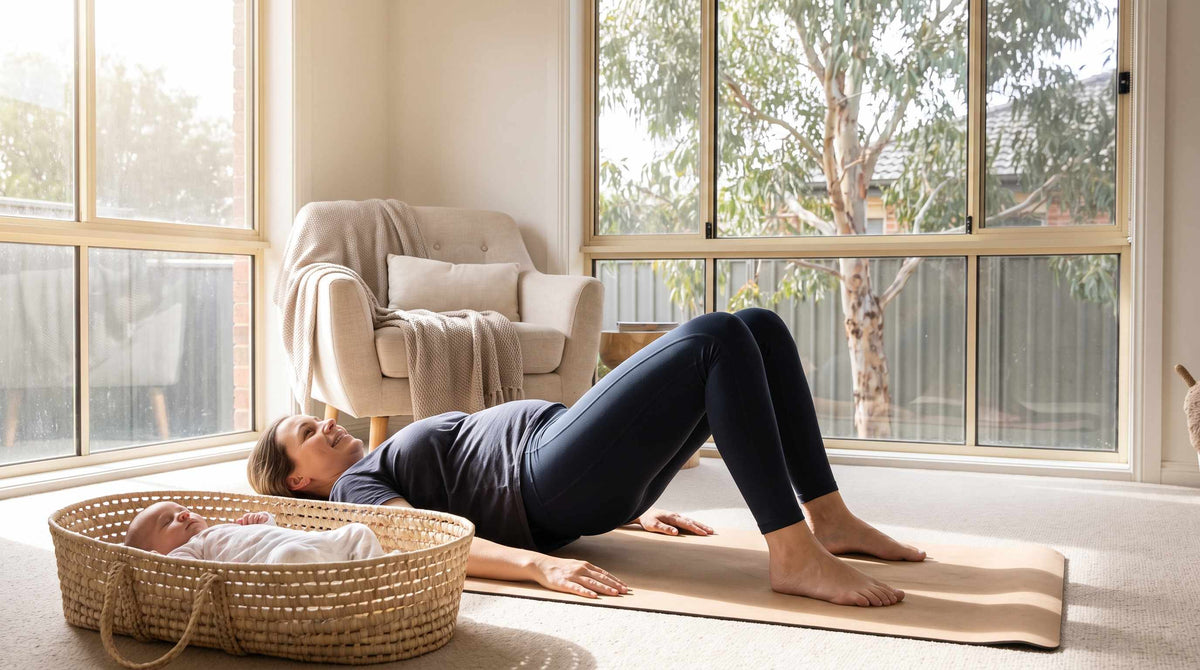

Having a baby changes everything — and for many new mums across the country, that includes their relationship with their own body. Despite how common it is, postpartum pelvic floor recovery in Australia rarely gets the open conversation it deserves — the Continence Foundation of Australia estimates that millions of Australians live with some form of bladder or bowel leakage, with postpartum women among the most commonly affected groups. Whether you experienced a vaginal birth, an assisted delivery, or a caesarean section, understanding what happens to your pelvic floor — and how to heal it — is one of the most important investments you can make in your long-term health and wellbeing.
What postpartum pelvic floor changes mean for your body
The pelvic floor is a group of muscles, ligaments, and connective tissues that sit like a hammock at the base of the pelvis, supporting the bladder, uterus, and bowel. During pregnancy, these structures bear the growing weight of your uterus for nine months, placing sustained downward pressure on muscles and fascia that are simultaneously being softened by the hormone relaxin. During a vaginal birth, the pelvic floor stretches to extraordinary lengths — sometimes sustaining tears or requiring an episiotomy — while a caesarean section can still affect pelvic floor function through pregnancy-related pressure, altered core mechanics, and post-surgical scar tissue that changes how the abdominal and pelvic muscles work together.
After birth, many women notice symptoms that can feel alarming but are, in fact, very common. Urinary leakage when coughing, sneezing, laughing, or exercising — known as stress urinary incontinence — is perhaps the most widely reported postpartum symptom. Others experience a sudden, strong urge to urinate that is difficult to defer (urgency incontinence), or a heaviness and bulging sensation in the vagina that may indicate pelvic organ prolapse. Some women experience pelvic girdle pain, reduced sensation during intimacy, difficulty emptying the bladder completely, or unexpected changes in bowel habit. It's not uncommon for several of these symptoms to occur simultaneously, which can feel overwhelming when you're also navigating the demands of caring for a newborn.
The difference between what's common and what's normal is a crucial distinction that Australian women's health advocates are working hard to communicate. These symptoms are common — affecting a significant proportion of postpartum women across Australia — but they're not something you simply have to accept as a permanent feature of motherhood. The encouraging news is that evidence-based treatment, guided by a qualified women's health physiotherapist, can lead to meaningful, lasting improvement for most women, particularly when begun promptly.
Warning signs that warrant prompt assessment by a healthcare professional include:
- Leaking urine during everyday activities such as walking, lifting, sneezing, or exercise
- Inability to reach the toilet in time due to sudden, urgent bladder sensation
- A feeling of heaviness, dragging, or something falling out of the vagina
- Pelvic or lower back pain that persists beyond six weeks postpartum
- Difficulty fully emptying the bladder or bowel after going to the toilet
- Pain during intercourse when returning to sexual activity after birth
Who is affected and why postpartum pelvic floor recovery matters in Australia

Pelvic floor dysfunction after childbirth is far more widespread than most people realise. Many Australian women quietly manage symptoms for years — sometimes decades — before seeking help, often because they feel embarrassed, assume it is simply the price of motherhood, or simply do not know that effective treatment exists. The Continence Foundation of Australia actively campaigns to break down this stigma, reminding women and healthcare providers alike that leakage is common but treatable, and that early intervention consistently produces the best outcomes.
First-time mothers, women who have had multiple pregnancies, those who experienced a prolonged second stage of labour, and those who delivered a large baby or required forceps or vacuum assistance are at higher risk of significant pelvic floor injury. Perineal tears — particularly third- and fourth-degree tears involving the anal sphincter — require specific rehabilitation pathways that go beyond standard pelvic floor exercise advice. However, even women who have had uncomplicated births or planned caesarean sections can experience postpartum pelvic floor symptoms due to the hormonal and biomechanical changes of pregnancy itself, making universal postnatal screening an important public health goal.
Access to postpartum pelvic floor recovery support in Australia is profoundly shaped by geography. A mum in inner-city Sydney or Melbourne may have ready access to bulk-billing women's health physiotherapists, specialist urogynaecology units, and continence clinics with short wait times. A woman in regional Queensland, rural South Australia, or remote Western Australia may face considerably longer waits and greater out-of-pocket costs. Telehealth has expanded access meaningfully since 2020, allowing many women in outer suburban and regional areas to receive initial assessments, exercise programmes, and ongoing follow-up from qualified practitioners without the burden of long travel — a development that has been widely welcomed by the Australian Physiotherapy Association and continence advocacy groups.
The economic and social toll of untreated pelvic floor dysfunction is equally significant. Incontinence affects workplace participation, exercise habits, intimate relationships, and mental health. Addressing pelvic floor health postpartum is not a luxury — it is a matter of women's health equity, and one that Australian health policy is gradually giving the attention it deserves.

Evidence-based care pathways Australians can access
The gold standard for postpartum pelvic floor recovery is assessment and supervised rehabilitation by a women's health physiotherapist — a specialist field formally recognised by the Australian Physiotherapy Association. A pelvic floor physiotherapist will conduct an internal and external assessment to evaluate muscle strength, tone, coordination, and any signs of prolapse, injury, or hypertonic dysfunction. From this baseline, they design a personalised rehabilitation programme that progresses systematically as your strength and function improve, adapting to your birth history, symptoms, fitness goals, and lifestyle.
A general postpartum recovery timeline
While every woman's journey differs, a broad framework helps set realistic expectations and informs conversations with your care team:
- Weeks 1–6: Prioritise rest, gentle diaphragmatic breathing, and very light pelvic floor activation in lying positions. Avoid heavy lifting, high-impact exercise, and anything that creates strong downward pressure on the pelvic floor, including straining on the toilet.
- Weeks 6–12: The six-week maternal health check with your GP or midwife is a critical milestone and an ideal opportunity to raise any bladder, bowel, or pelvic symptoms. Begin a structured pelvic floor exercise programme under professional guidance rather than a generic self-directed approach.
- Months 3–6: Progressive functional loading — introducing brisk walking, swimming, and gentle Pilates or yoga as your symptoms allow. A physiotherapist can guide how to modify activities that increase intra-abdominal pressure.
- Months 6–12: For many women, this window is when return to running, high-intensity gym training, or competitive sport is assessed using evidence-based criteria, such as the ability to perform single-leg hops, jogging on the spot, and loaded squats without leakage, urgency, or pelvic heaviness.
Your GP is a crucial first point of contact throughout this journey. The Royal Australian College of General Practitioners (RACGP) recommends that postnatal checks routinely include screening for incontinence and pelvic floor symptoms, yet many women don't raise these concerns unless directly asked — and many GPs do not ask. If your GP doesn't bring it up, please raise it yourself. A GP referral to a women's health physiotherapist may attract a Medicare rebate under a Chronic Disease Management (CDM) plan if your symptoms are ongoing and affecting your daily function, making care more affordable for many Australian families.
Medicare Australia also funds visits to continence nurse practitioners in some public settings, and the National Continence Program supports specialist continence clinics within the public hospital system across several states and territories. For personalised, confidential advice at no cost, the National Continence Helpline is available on 1800 33 00 66, staffed by experienced continence nurses who can help you understand your symptoms, identify local services, and provide guidance on products and management strategies — a genuinely valuable resource for women who aren't sure where to start.
Pelvic floor muscle training (PFMT) underpinned by physiotherapy assessment remains the first-line, evidence-based treatment recommended in Australian and international clinical guidelines. Biofeedback, electrical stimulation, bladder training, prolapse management strategies, and activity modification may also be incorporated depending on your specific presentation. In some cases where conservative treatment has not achieved satisfactory results after a sustained trial, a referral to a urogynaecologist or colorectal surgeon may be the appropriate next step.
How Orykas washable incontinence underwear supports daily confidence
Rehabilitation takes time — and during those weeks and months of postpartum recovery, many Australian women are looking for practical, everyday solutions that allow them to get on with life without anxiety or embarrassment. Disposable pads and liners remain a common choice, but an increasing number of Australian mums are switching to reusable, washable incontinence underwear, which offers a more sustainable, comfortable, and discreet alternative that fits naturally into a busy postnatal routine.
Orykas designs premium washable incontinence underwear specifically for Australian women, combining ultra-absorbent technology with everyday styles that look and feel like regular underwear. The difference for postpartum women is meaningful: instead of managing a disposable pad that shifts, bunches, or requires constant changing in the middle of a hectic day with a newborn, you simply put on a pair of Orykas pants in the morning and get on with your day — whether that is a school run in Brisbane, a walk around the park in Canberra, or working from home during nap time.
For women who prefer a supportive, higher-coverage fit during early postpartum recovery, our high-waisted washable incontinence pants offer gentle abdominal support alongside reliable leak protection — a popular choice for mums navigating those first few months when core and pelvic floor muscles are still rebuilding. If you prefer something a little more feminine for everyday wear as you progress through recovery, our lace-waistband washable incontinence pants deliver the same level of absorbency in a softer, more elegant style that sits comfortably under regular clothing without visible lines or bulk.
To find the style and absorbency level that suits your needs at each stage of recovery, browse our complete women's washable incontinence underwear collection, which includes options across a range of absorbency levels for light, moderate, and heavier leakage. Washable underwear is not a substitute for physiotherapy or medical care — but it's a genuinely useful confidence-building tool that allows women to remain active, pursue rehabilitation exercises, and engage fully in daily life while their pelvic floor heals. Each pair is machine washable, built to last for many laundry cycles, and designed to reduce both long-term cost and environmental impact compared with ongoing disposable use.
NDIS, CAPS, and funding options for Australians
Navigating the funding landscape for continence-related products and services in Australia can feel overwhelming, particularly when you're also managing the financial adjustments that come with a new baby. Several pathways exist that are worth exploring with your GP, continence nurse, or allied health coordinator, and many women are surprised to find that more support is available than they assumed.
The Continence Aids Payment Scheme (CAPS), administered by Services Australia, provides a yearly payment to eligible Australians with permanent and severe incontinence to help offset the cost of continence products. CAPS eligibility is assessed through your GP alongside a registered continence professional — if you believe your postpartum incontinence is likely to be long-term rather than transient, it's worth asking your GP whether an assessment for the scheme is appropriate for your situation.
For women who have an existing disability or who acquire a disability related to birth injury, the National Disability Insurance Scheme (NDIS) may fund continence assessments, physiotherapy, and continence aids and equipment as part of an individual support plan. NDIS participants should speak with their planner or Local Area Coordinator about including continence support in their next plan review, particularly if pelvic floor dysfunction is significantly affecting daily activities or community participation.
Additional funding and support options worth exploring include:
- Medicare Australia rebates for GP consultations, and allied health services under a Chronic Disease Management referral
- Private health insurance extras cover for physiotherapy and continence-related allied health, which varies by fund and level of cover
- State-funded public hospital continence clinics, available in most major cities including Adelaide, Perth, and Melbourne
- Community health centres offering low-cost or bulk-billing physiotherapy, particularly in outer suburban and regional areas
- The National Continence Helpline (1800 33 00 66), which can provide free referrals to local funded or subsidised services
It's always worth asking your GP, midwife, or a continence nurse to help you identify what support you may be entitled to before committing to full out-of-pocket costs. Australian healthcare can be difficult to navigate, but the resources exist — particularly through the National Continence Program — to help women access care regardless of where they live or their financial circumstances.
Frequently asked questions
How long does postpartum pelvic floor recovery take?
There is no single timeline, as recovery depends on the type of birth, the degree of pelvic floor injury, the consistency of rehabilitation, and individual factors such as age, general fitness, and hormonal status — breastfeeding lowers oestrogen, which can affect tissue healing and bladder sensitivity. Many women see meaningful improvement within three to six months of beginning a structured physiotherapy programme. Others, particularly those with significant pelvic floor injury or prolapse, may find their recovery takes twelve months or longer. The Australian Physiotherapy Association emphasises that it's never too late to begin pelvic floor rehabilitation, even years after your most recent birth.
Should I see a physiotherapist even if my symptoms seem mild?
Yes — early assessment is strongly recommended even for mild symptoms. What presents as minor leakage or slight heaviness at six weeks postpartum can worsen with subsequent pregnancies, high-impact activity, or the declining oestrogen of perimenopause if the underlying muscle dysfunction is not addressed. A women's health physiotherapist can identify issues that may not yet be causing significant symptoms and provide early intervention that prevents problems from escalating. Many Australian women wait years before seeking professional help; earlier is always preferable, and the six-week postnatal check is the ideal first opportunity to raise any pelvic concerns with your GP.
Are pelvic floor exercises alone enough to support postpartum recovery?
Pelvic floor exercises — often called Kegel exercises — are a foundational element of recovery, but they're most effective when personalised by a qualified physiotherapist. Some women present with an overactive or hypertonic pelvic floor rather than a weak one, and in those cases, standard Kegel exercises can worsen symptoms rather than improve them. A thorough physiotherapy assessment determines whether you need strengthening, relaxation, coordination training, or a combination of approaches, and adjusts the programme as your function changes over time. Apps and pamphlets offering generic pelvic floor exercise programmes are a reasonable starting point but should not replace professional assessment when symptoms are present or persistent.
What continence products work best for postpartum women during recovery?
The right product depends on your level of leakage, daily activities, and personal preference. Many postpartum women find that washable, reusable incontinence underwear offers a more comfortable and discreet alternative to disposable pads, particularly for light to moderate leakage during exercise, walking, or everyday tasks. Products designed specifically for urinary incontinence — rather than period underwear — feature a dedicated absorbent core that draws moisture away from the skin and manages leaks reliably without bulk. A continence nurse can help you identify the most appropriate product for your situation; you can reach one for free through the National Continence Helpline on 1800 33 00 66.
This article is informational and does not replace advice from your GP, a qualified continence nurse or a specialist.
Share:
9 everyday habits that make bladder leaks worse for Australian women
Menopause and bladder control: what Australian women over 50 need to know