



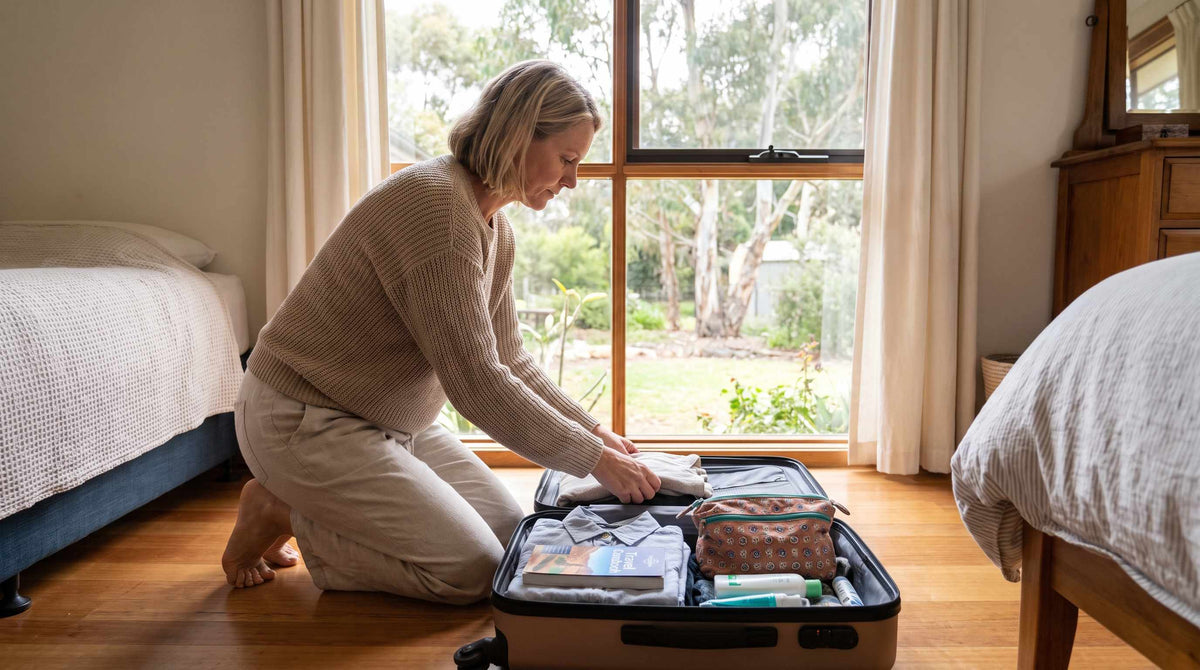
Whether you're planning a weekend getaway to the Blue Mountains, a cross-country drive from Adelaide to Perth, or an international holiday, travelling with incontinence doesn't have to mean staying home. With a little preparation — and the right items in your suitcase — you can explore confidently and comfortably. This packing checklist covers everything from underwear and accessories to funding options, so you can focus on the adventure ahead rather than worrying about leaks.
Why travel can make incontinence symptoms worse
A change in routine is one of the most common triggers for urinary leakage. At home, you know exactly where the nearest bathroom is. On the road or in the air, that certainty disappears. Dehydration from air-conditioned cabins, unfamiliar food, disrupted sleep patterns and limited toilet access can all increase urgency and frequency.
Stress incontinence — leaking when you cough, laugh or lift a heavy bag — can also flare up during travel. Carrying luggage, rushing through airports, and sitting for hours in cramped positions puts extra pressure on your pelvic floor. If you're managing incontinence while travelling through regional Australia, the vast distances between rest stops on outback highways add another layer of anxiety.
Here's the thing: understanding these triggers is the first step. The second is packing smartly so that, whatever happens, you're prepared.
Your essential packing checklist for incontinence-friendly travel
A well-thought-out packing list removes guesswork and builds confidence. Below is a checklist designed specifically for Australian women managing incontinence on the go.
Clothing and underwear essentials
- Two to three pairs of washable incontinence underwear — enough to rotate while one pair dries. The Women's High-Waisted Washable Incontinence Pants from Orykas are discreet enough to wear under travel clothes and absorbent enough for long journeys.
- A dedicated Waterproof Carry Pouch for storing used underwear when you're away from laundry facilities — it seals in moisture and odour, fitting easily inside a handbag or daypack.
- Dark-coloured bottoms (navy, black, charcoal) that camouflage any minor accidents and dry quickly.
- A spare outfit in your carry-on bag, not just your checked luggage, in case of delays or spills mid-flight.
If you're travelling for more than a few days, consider packing the 3-Pack Ultra Absorbent Beige Incontinence Briefs for a neutral option that sits invisibly under lighter clothing in warmer destinations like Cairns or Darwin.
Laundry and hygiene supplies
- A Machine Wash Bag to protect your washable underwear in hotel or caravan-park laundry machines.
- Travel-sized, pH-balanced intimate wash — ordinary soaps can irritate sensitive skin.
- Biodegradable wet wipes for freshening up between showers.
- A small zip-lock bag with a change of underwear and wipes you can keep in your handbag for day trips.
- Hand sanitiser — regional Australian rest stops don't always have soap.
Keeping these items together in a single toiletry pouch means you can grab them quickly without rummaging through your suitcase in a public restroom.

Tips for flying, road trips and long-distance travel
Australia's sheer size means many domestic trips involve hours of transit. Whether you're flying Sydney to Melbourne or driving through the regions, a few simple strategies make a big difference.
On flights, book an aisle seat near the rear lavatories so you can reach them without climbing over fellow passengers. Drink water in small, regular sips rather than gulping a whole bottle — dehydration worsens urgency, but so does a suddenly full bladder. It's best to avoid caffeine and alcohol before and during the flight, as both are bladder irritants.
On road trips, plan your rest stops in advance. Apps like Toilet Map Australia (supported by the Continence Foundation of Australia) pinpoint public toilets across the country, including accessibility ratings. Aim to stop every ninety minutes to two hours, which also helps prevent deep-vein thrombosis on long drives. Keep your waterproof pouch and a spare pair of incontinence underwear in the glove box or a seat-back organiser — not buried in the boot.
For bus and rail journeys between cities like Brisbane and the Gold Coast, or the Indian Pacific across the Nullarbor, familiarise yourself with onboard toilet locations as soon as you board. Wearing washable incontinence underwear gives you a reliable backup if the queue's long or the facilities are occupied.
Managing incontinence at your destination
Arriving at your accommodation is a good time to reset. Locate the nearest bathroom, check that laundry facilities are available, and hang a washable pair of incontinence underwear to air-dry overnight so you've always got a fresh pair ready.
If you're staying in a hotel, most Australian hotels provide a laundry bag in the wardrobe — use it alongside your machine wash bag to keep things organised. For camping or caravan holidays, a collapsible bucket and biodegradable soap let you hand-wash underwear at the campsite.
Sightseeing days require a bit of extra planning. Before heading to attractions in Melbourne's Southbank or Sydney's Circular Quay, check the Toilet Map app for nearby facilities. Wearing your Orykas washable underwear underneath your day outfit means one less thing to worry about while you enjoy the experience.
Evidence-based care before you travel
Preparation isn't just about packing — it's also about getting your health in order. Before a big trip, consider booking an appointment with your GP to review your incontinence management plan. Many bulk-billing GPs can refer you to a continence physiotherapist under a Medicare-funded Chronic Disease Management plan, giving you access to up to five allied-health sessions per calendar year.
A continence physiotherapist can teach you pelvic-floor exercises tailored to travel scenarios — for example, "the knack," a quick squeeze before coughing or lifting luggage that can significantly reduce stress-incontinence episodes. The Continence Foundation of Australia recommends that women practise these exercises daily for at least three months to see meaningful improvement.
If you take medication for overactive bladder, have a chat with your GP or pharmacist about timing doses around travel schedules and time zones, especially for international trips. Make sure you've got enough medication for the entire trip plus a buffer, and carry prescriptions in your hand luggage.
NDIS, CAPS and funding options for Australians
Managing incontinence can involve ongoing costs, but several Australian Government programmes can help offset expenses — including when you're purchasing supplies for travel.
The Continence Aids Payment Scheme (CAPS), administered by Services Australia, provides an annual payment to eligible Australians to help cover the cost of continence products. To access CAPS, you'll need an assessment from a continence professional and a referral from your GP. The scheme can help fund washable and disposable products alike, making it easier to stock up before a holiday.
If you have an NDIS plan that includes continence supports, talk to your plan manager or support coordinator about whether travel-related continence products fall within your funded categories. Many participants find that washable underwear is a cost-effective choice over disposables, especially for longer trips where packing dozens of single-use pads isn't practical.
For general advice or to find a continence professional near you, call the National Continence Helpline on 1800 33 00 66. The helpline is staffed by continence nurse advisors who can answer questions about products, funding, and specialist referrals — a useful call to make well before your departure date.
Frequently asked questions
Can I take washable incontinence underwear through airport security?
Yes. Washable incontinence underwear is treated like any other clothing by airport security in Australia and internationally. There's no need to declare it or remove it from your luggage during screening. Pop a clean pair in your carry-on for easy access during the flight.
How many pairs of incontinence underwear should I pack for a week-long trip?
Three to four pairs is usually sufficient if you've got access to laundry facilities. Washable options like Orykas incontinence briefs dry relatively quickly when hung overnight, so you can rotate them throughout the week. If you're camping or won't have laundry access, consider packing one pair per day.
Are there travel-friendly incontinence products for Australian women?
Absolutely. Reusable incontinence underwear is increasingly popular with Australian women who travel, because it reduces waste and luggage bulk. A waterproof carry pouch is also invaluable for discreetly storing used pairs when you're out for the day. These products are available from Australian online retailers and can be delivered before your trip.
Does Medicare cover continence assessments before travel?
Medicare covers GP consultations, and your doctor can create a referral for a continence physiotherapist under a Chronic Disease Management plan. While Medicare doesn't specifically cover "travel preparation," a pre-trip continence review falls under standard care pathways. Ask your GP about a suitable referral at your next visit.
This article is informational and does not replace advice from your GP, a qualified continence nurse or a specialist.
Share:
Discreet incontinence underwear for work and formal wear
CAPS (Continence Aids Payment Scheme) for Australian women