



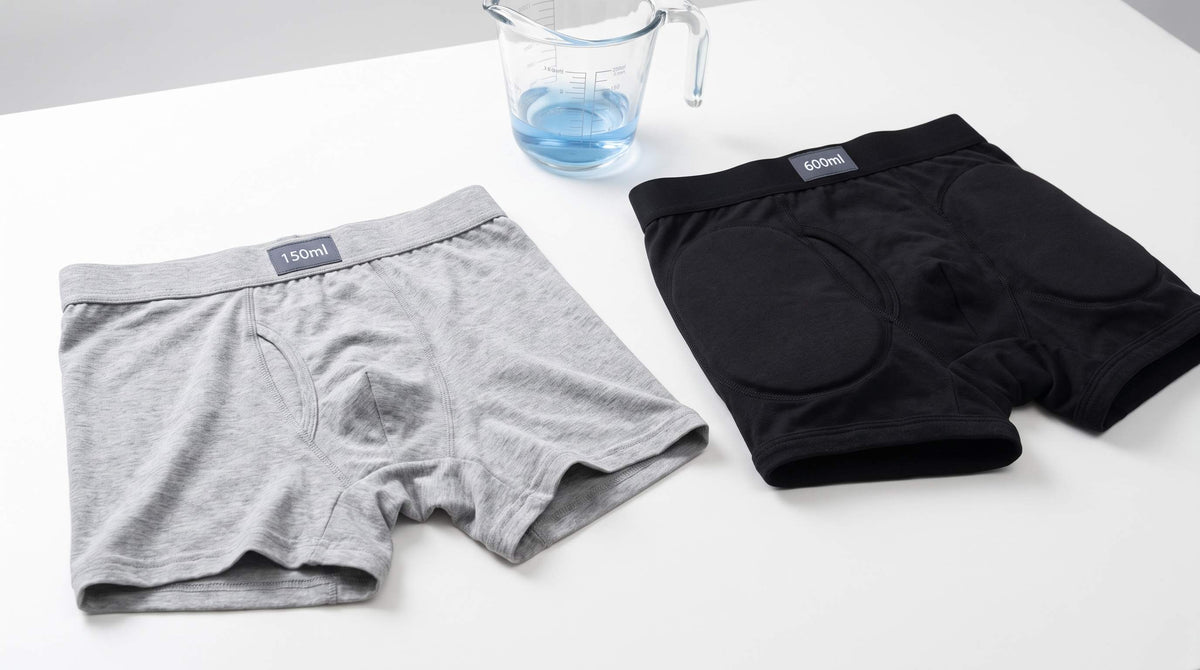

Choosing between a lighter and a heavier-duty option is one of the most practical decisions any man dealing with urinary leakage will face, and yet the topic rarely gets a straight answer. As more Australian men turn to discreet, comfortable, and reusable alternatives to single-use pads, understanding the range of incontinence boxer absorbency levels available across Australia has never been more relevant. Whether you're a bloke in regional Queensland managing post-prostatectomy dribble or a Sydney office worker dealing with urgency leaks, picking the right absorbency level can mean the difference between getting on with your day confidently and spending it preoccupied with worry.
What absorbency ratings actually mean
When a washable incontinence boxer is labelled "150ml" or "600ml," the number refers to the maximum volume of liquid the built-in absorbent gusset can hold before saturation. It's a standardised measurement used across washable underwear brands to give buyers a consistent reference point, similar to the way sunscreen is rated by SPF. The higher the number, the more fluid the garment can retain against the skin before leakage escapes to clothing.
What matters equally, though, is the rate at which fluid is absorbed. A well-designed boxer should wick moisture away from the skin quickly, lock it into an absorbent core, and present a dry-feeling surface — protecting both comfort and skin integrity. Prolonged skin contact with moisture is a real concern; the Continence Foundation of Australia notes that poor moisture management can contribute to dermatitis and skin breakdown, particularly for men with reduced mobility.
Bear in mind that absorbency ratings are measured under controlled laboratory conditions. Real-world usage — moving around, exercising, or experiencing a sudden urge leak — can affect how a boxer performs in practice. That's why knowing your own leakage pattern, and not just a number, is the most useful starting point.
Identifying your leakage type before choosing a boxer

Urinary incontinence in men takes several forms, and the type you experience should directly guide your absorbency choice. Stress incontinence — leaks triggered by coughing, sneezing, or lifting — typically produces smaller, unpredictable volumes and is common in men who have had prostate surgery. Urgency incontinence involves a sudden, strong urge to urinate that's difficult to defer, and can result in larger releases if the bladder empties fully. Many men experience a mix of both, referred to as mixed incontinence.
If you're unsure which type you have, a bulk-billing GP can refer you to a continence physiotherapist or specialist. The RACGP encourages GPs to routinely screen for incontinence in men over 50, recognising it as an underreported condition. You can also call the National Continence Helpline on 1800 33 00 66 — a free, confidential service staffed by continence nurses who can guide you toward the right assessment and products.
Keeping a simple bladder diary for 48 to 72 hours — noting every void, every leak, and an estimated volume — is one of the most practical tools for understanding your own pattern before you invest in a product range. Your continence nurse or GP may provide a structured template, or you can download one from the Continence Foundation of Australia's website.
Quick guide: which leakage pattern suits which absorbency?
- Light drips and post-void dribble: a 150ml option is generally sufficient and offers a slimmer, more discreet profile
- Occasional small stress leaks (sneezing, coughing, lifting): 150ml to moderate absorbency works well for most men in this category
- Urgency leaks where some or all of the bladder empties: 600ml provides a far greater safety margin
- Overnight protection: a higher-capacity option significantly reduces the risk of saturation during longer periods without a toilet visit
- Post-prostatectomy recovery: early recovery stages often warrant the maximum absorbency available, tapering down as continence improves
- Active lifestyle — sport, outdoor work, travel: higher absorbency gives more confidence during longer periods away from a toilet
The 150ml boxer: comfort and discretion for lighter leaks
A 150ml washable boxer is designed for men managing light to mild leakage — post-void dribble, occasional small stress leaks, or light urgency that rarely results in a large release. The key advantage is feel: a lower-capacity gusset typically means a slimmer overall profile, closer to the look and weight of standard underwear. Many men describe this as a significant confidence boost, particularly those returning to work or social activities during incontinence recovery.
The Orykas absorbent boxer for light leaks sits squarely in this category, offering a washable, reusable option with a discreet cut suited to everyday use. For men whose leakage is predictable and modest in volume, a 150ml capacity worn with a regular bathroom routine is often entirely sufficient — and the ability to machine-wash and reuse the garment makes it a far more economical and sustainable long-term choice than disposable pads.
One thing to bear in mind is that a 150ml boxer shouldn't be treated as a backup for heavier leakage. If you regularly exceed the capacity, you'll find the garment reaching saturation and moisture migrating to outer clothing — exactly what you're trying to avoid. Being honest with yourself about your actual leakage volume is more important than opting for the slimmer silhouette.
The 600ml boxer: serious protection for moderate to heavy leakage
A 600ml absorbency level is a substantial step up. Designed for men dealing with moderate to heavy urinary incontinence — those experiencing significant urgency leaks, early post-operative recovery, or neurological conditions affecting bladder control — a high-capacity boxer provides meaningful protection over an extended period without requiring a change. This matters enormously for quality of life, particularly for men in Perth or regional Australia who may work long shifts, spend time outdoors, or face limited access to private facilities.
The Orykas men's washable incontinence boxer briefs are built for exactly this level of demand. The extended absorbent zone and multi-layer construction are engineered to handle higher volumes while keeping moisture locked away from the skin. Despite the higher capacity, modern construction techniques mean these boxers remain far less bulky than traditional adult pads or pull-ups, and they can be worn under regular clothing without an obvious profile.
For those who prefer a brief cut rather than a boxer silhouette, the men's washable incontinence briefs offer the same high-absorbency performance in a different fit profile — worth considering if a more traditional brief style is more comfortable for your body shape or daily activity level.
Here's where the extra capacity really shows its worth: overnight use is where a 600ml boxer tends to outperform lighter options most dramatically. Bladder activity during sleep varies between individuals, but for men who experience nighttime urgency or who simply can't interrupt sleep for frequent bathroom visits, a higher-capacity garment provides considerably more security through the night.
Cost breakdown for Australian buyers
One of the most compelling arguments for washable incontinence underwear — at any absorbency level — is the long-term cost comparison with disposables. Single-use pads and pull-up pants represent a recurring weekly expense that adds up significantly over months and years, whereas a washable boxer, cared for properly, can last for hundreds of washes.
For Australians managing ongoing incontinence, it's worth knowing that financial support may be available. The Continence Aids Payment Scheme (CAPS), administered through Services Australia, provides an annual payment to eligible Australians with permanent and severe urinary or faecal incontinence to help offset the cost of continence aids. CAPS is income-tested and requires a supporting medical certificate, so speak with your GP about eligibility. Separately, NDIS participants with relevant support needs may be able to access funding for continence products as part of their NDIS plan — a continence physiotherapist can assist with the appropriate evidence and assessment.
- CAPS: an annual payment via Services Australia for eligible individuals with permanent and severe incontinence
- NDIS plans: may include funding for continence aids under daily activities or health supports, depending on individual circumstances
- Medicare Australia: covers GP and specialist consultations and referrals to continence physiotherapists under standard Medicare arrangements
- Bulk-billing GPs: accessing an initial assessment and referral at no out-of-pocket cost is possible through bulk-billing practices in most capital cities and many regional centres
- Washable vs disposable cost: while washable underwear involves a higher upfront investment, the per-use cost drops substantially over time, often making it the more economical option within a few months
If you're not yet sure which absorbency level suits you, the Orykas Discovery Set is a practical starting point — a way to trial different styles before committing to a full drawer of one type. This is particularly useful for men still managing variable leakage during recovery, where needs may change from week to week.
How Orykas fits into the Australian market
The washable incontinence underwear market in Australia has grown considerably as consumer awareness has caught up with the quality that modern reusable products offer. Orykas positions itself as a premium option focused on fit, absorbency performance, and discretion — qualities that matter most to men who want to manage incontinence without compromising how they dress or move through their day.
The full men's washable incontinence underwear range covers both lighter and heavier absorbency levels, with cuts designed to sit comfortably under standard clothing. Orykas ships Australia-wide, including to regional and remote areas where access to specialist incontinence products in physical stores is more limited — a practical consideration for men in areas like outback Queensland, rural Victoria, or regional Western Australia.
Compared with disposable options, washable underwear requires a small adjustment — a dedicated laundry routine and enough pairs to rotate through wash cycles. Most users find two to four pairs sufficient for weekday rotation. The environmental benefit of eliminating single-use waste is an added consideration for environmentally conscious Australian consumers, though the primary driver for most men is comfort, discretion, and long-term cost.
Frequently asked questions
Can I use a 150ml boxer for post-prostatectomy leakage?
It depends on where you are in your recovery. In the early weeks following a prostatectomy, leakage volumes are often substantial, and a 600ml capacity boxer or higher is typically more appropriate. As recovery progresses and pelvic floor rehabilitation takes effect, many men find they can transition to a lighter absorbency option. Your continence physiotherapist is the best person to guide this transition based on your bladder diary and pelvic floor progress.
How do I know if I'm choosing the right incontinence boxer absorbency level for my needs?
The simplest method is a bladder diary: track your leaks over two to three days, noting the approximate volume and what triggered each episode. If you're consistently leaking less than 150ml per episode and your leaks are infrequent, a lighter absorbency option will likely suffice. If you're experiencing larger or more frequent leaks, a 600ml option offers a more reliable safety margin. When in doubt, start with a higher absorbency — you can always downgrade as your confidence grows or your condition improves. The National Continence Helpline on 1800 33 00 66 can also offer practical guidance at no cost.
Are washable incontinence boxers covered by the NDIS or CAPS?
Continence aids, including washable underwear, may be covered under CAPS (Continence Aids Payment Scheme) through Services Australia, subject to eligibility criteria including permanence and severity of the condition and an income test. NDIS participants may also have continence aids funded as part of their plan under relevant support categories. In both cases, a supporting assessment from a GP or continence nurse is required. Speak with your GP or contact Services Australia directly to check your eligibility and current payment amounts.
How many washable boxers do I need to buy?
A practical starting point for most men is three to five pairs, which allows for a daily change plus sufficient rotation through a standard wash and dry cycle. If your leakage requires more frequent changes — for example, during heavy-leakage phases of post-operative recovery — you may prefer to have more pairs on hand. Machine-washing on a gentle cycle and air-drying where possible will maximise the lifespan of the absorbent layers. Avoiding tumble-drying on high heat is generally recommended to preserve the integrity of the absorbent gusset over time.
This article is informational and does not replace advice from your GP, a qualified continence nurse or a specialist.
Share:
Washable vs disposable incontinence products: an Australian cost comparison
7 questions Australian men are too embarrassed to ask about incontinence